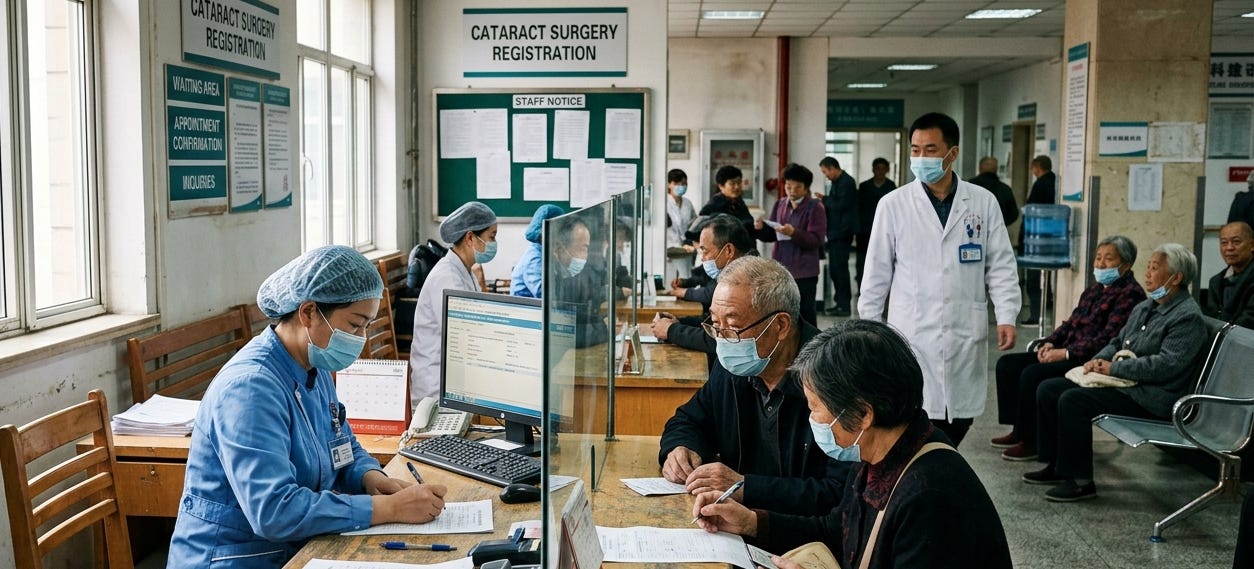
On 13 April 2026, China’s NHC published its national adult cataract surgery operating standard. Seventeen days later, it issued a separate directive to health authorities in 24 provinces ordering county-level hospitals to implement it. The second document is not a clarification. It is a correction signal, and it tells you precisely where the IOL market is about to come under pressure.
I. The Policy: What Notice No. 134 Requires
On 29 April 2026, NHC’s Medical Administration Bureau published Notice [2026] No. 134 (国卫办医政函 [2026] 134号), addressed to provincial and autonomous region health authorities across 24 jurisdictions. The list is deliberate: Hebei, Shanxi, Inner Mongolia, Liaoning, Jilin, Heilongjiang, Anhui, Fujian, Jiangxi, Henan, Hubei, Hunan, Guangdong, Guangxi, Hainan, Sichuan, Guizhou, Yunnan, Tibet, Shaanxi, Qinghai, Gansu, Ningxia, Xinjiang, and the Xinjiang Production and Construction Corps. Beijing, Shanghai, Zhejiang, Jiangsu, and Shandong are absent. This is a targeted intervention in the provinces where county-level medical capability is structurally weakest.
The notice imposes four requirements on county hospitals. First, establish a quality management system covering the full surgical pathway, pre-operative assessment, intraoperative procedure, post-operative follow-up, and internal audit cycles. Second, comply in full with the adult cataract surgery operating standard issued on 13 April (国卫办医政函 [2026] 117号 / Notice [2026] No. 117). Third, implement full-cycle traceability for all implantable devices, including intraocular lenses, and prohibit the reuse of single-use instruments. Fourth, accept oversight from provincial blindness prevention technical groups and participate in NHC-organised national inspection visits.
The document sets no specific remediation deadline. What it does announce is that NHC will organise inspection visits. That announcement is the operative pressure mechanism.
II. The Seventeen-Day Gap
NHC issued Notice No. 117 on 13 April. It published Notice No. 134 on 29 April. The interval is 17 days.
Ministries do not issue targeted enforcement follow-ups 17 days after a national standard unless they have already concluded that the standard will not be implemented without additional administrative force. The sequencing is the signal. NHC has assessed that county-level health systems in these 24 provinces will not reach compliance through normal policy diffusion, and has acted accordingly.
This is the policy-execution gap made visible. National technical documents, once issued, do not automatically translate into changed behaviour in a county hospital in Guizhou or Yunnan. The pathways through which a ministry notice reaches an operating theatre, provincial relay, institutional awareness, staff training, system procurement, workflow change, each introduce delay and attenuation. Notice No. 134 is NHC’s acknowledgement that those pathways, left alone, will not close the gap within an acceptable timeframe.
The commercial implication follows directly. The county-level IOL market is not in a phase of smooth expansion, temporarily complicated by a compliance requirement. It is in a phase of forced supply-side consolidation: facilities that cannot demonstrate compliance will reduce or suspend elective procedures; those that can will absorb the volume that shifts toward them.
III. County Hospitals: The Structural Context
The following reflects OphthalLogix’s market observation and analytical judgement, not verifiable regulatory data.
Talent and capability hierarchy
County hospitals sit at the base of China’s medical capability hierarchy. Talent flows toward provincial and city-level institutions; county facilities receive what the pipeline does not retain. An ophthalmologist operating at a county hospital in a recipient province has typically completed a training rotation at a higher-tier institution and returned to serve a local population, building experience more slowly, with less peer access, and against limited annual procedure volume. Annual case volume at some county facilities is modest enough that technical proficiency accrues slowly. This is not a criticism of the individuals involved; it is a structural feature of how China’s medical training system concentrates human capital.
Infrastructure baseline
Medical record systems at the county level remain heterogeneous. Many facilities operate in a transitional state between paper-based and digital records, with hospital information systems that were not designed for the kind of implant-level data linkage that IOL traceability now demands. Prior to Notice No. 134, IOL management at the point of care was, in much of this market, a manual process: physical product labels attached to surgical notes, without binding to patient records or connection to procurement and insurance settlement systems.
Full-cycle IOL traceability, connecting procurement, inventory management, surgical use, and medical insurance reimbursement through a continuous data trail, is an infrastructure project for most of these facilities, not an administrative update.
Compliance behaviour and the inspection dynamic
OphthalLogix assessment: The inspection announcement creates a de facto transition window. County facilities now know that NHC visits are coming; they do not know exactly when. That uncertainty functions as a compliance accelerant for facilities with the institutional capacity to respond, and as a deferral mechanism for those without. Historical patterns in Chinese healthcare regulation suggest that enforcement consequences accelerate sharply once the first inspection findings are publicised, regional administrations move quickly once a comparable facility has been cited. The hospitals that remediate in this window face administrative review. Those that do not face inspection findings with consequences that can include procedure restrictions and medical insurance designation reviews.
IV. Three Commercial Decisions This Reshapes
Volume forecasts require a new variable
Short-term county-level cataract procedure volume may contract. Facilities that cannot demonstrate compliance will reduce elective cases during remediation, not because patient demand has changed, but because the compliance risk of continuing without a functioning quality system has increased. Those patients do not disappear; they wait, or they travel to a city hospital. Neither outcome translates to near-term volume growth in the county segment.
Medium-term, as facilities reach compliance, volume will return, and likely grow beyond pre-policy levels, as quality-gated county hospitals become credible referral destinations within the primary care network. The timeline, however, is tied to inspection outcomes and institutional remediation capacity, not to demographic projections. Sales forecasts that model county-level IOL volume as a linear function of population ageing and procedure expansion, without a compliance progress variable, are currently overstated for the next 6 to 12 months and potentially understated for the 24 to 36 months that follow.
Distributor economics are shifting
IOL traceability at the county level changes the value equation for distributors. A distributor capable of supporting hospital staff through the operational requirements of compliant device management, documentation workflow, data linkage guidance, and staff orientation holds a competitive position that did not exist before 29 April. A distributor whose value is purely logistical faces a different conversation with hospital procurement teams operating under compliance pressure.
This restructuring will not happen uniformly. Provinces with stronger administrative follow-through on NHC mandates will move faster; others will calibrate to the inspection risk they actually perceive. The companies that understand this geography, which provinces will move quickly, which will interpret enforcement at the margin, will allocate distributor development resources more precisely than those that treat the 24-province directive as a single market event.
The execution window is open now
Between Notice No. 134’s publication on 29 April and the onset of NHC inspection visits, county-level commercial teams have a finite window to assess their covered hospitals. Which facilities have functioning IOL traceability systems? Which are remediation candidates? Which are at procedural risk? This is an information advantage that compounds quickly.
OphthalLogix assessment: Inspection visits are expected no earlier than Q3 2026, though no schedule has been announced. The approximate two-month gap between the notice date and a plausible inspection onset is a working window, not a margin of comfort. Teams that complete this assessment before inspections begin can anticipate volume disruption and position accordingly. Teams that begin after the first inspection findings circulate will be responding to events rather than leading them.
V. Key Implications
Twenty-four provinces of the county-level IOL market have entered mandatory quality compliance. This is not a transient regulatory moment; it is a structural reset of which facilities can credibly operate a cataract programme.
The 17-day interval between Notice No. 117 and Notice No. 134 is the most informative data point in both documents combined. It signals that NHC entered this process with an assessment already formed: county-level compliance, left to self-organise, would not arrive.
Short-term procedure volume contraction in the county segment is the probable near-term outcome of this policy sequence. Consolidation around compliant facilities is the structural one. For IOL companies, the competitive variable in the county segment has shifted: price alone no longer determines which products and distributors retain access. Traceability capability, distributor service quality, and hospital compliance support are now part of the equation.
The companies that recognised this before the inspection cycle began are positioned differently from those that recognised it after.
— The OphthalLogix Intelligence Team
This analysis is based on publicly available regulatory documents. It does not constitute legal, regulatory, investment, or medical advice. China’s healthcare policy environment moves quickly; verify before acting. OphthalLogix Intelligence accepts no liability for decisions made in reliance on this content.
intelligence@ophthallogix.com · www.ophthallogix.com