


Most descriptions of the Chinese intraocular lens market open with a national number: annual cataract procedures, average selling prices, and premium penetration rates. The numbers are not wrong. The market they describe, however, has quietly disappeared. There is no single Chinese IOL market any longer. There are three, and the gap between them is wide enough to matter.
Regime A · Beijing. Hard cap, with a legitimate escape valve.
Beijing caps IOL reimbursement by lens category, most recently RMB 1,835 per lens, under Beijing MSA [2020] No. 28. Patients may, however, legitimately pay the delta to a premium lens against a signed consent form. The mechanism exists on paper and is referenced in current reimbursement notices.
Regime B · Guangzhou. The reform of March 2025.
On 10 February 2025, the Guangzhou Medical Security Administration issued notice [2025] No. 1, removing the IOL reimbursement cap and moving to proportional payment. Guangzhou is, at the time of writing, the only tier-one Chinese metropolitan market to have done so. It is the single largest reimbursement change we have recorded in the past twelve months.
Regime C · DRG / DIP bundling.
Shanghai, Zhejiang, Jiangsu, Sichuan, Chongqing and others have moved cataract care into DRG or DIP case bundling. Under these regimes, the lens becomes a cost item inside a fixed case payment rather than a separately reimbursable consumable. That distinction, on its own, is enough to change the commercial logic of any IOL above the bundle’s implied lens allowance.
The 4th VBP anchors · binding for the next two to three years.
The 4th national volume-based procurement round is the second fact on which any current analysis of this market has to rest. The winning prices are now the payment standard in every province that has published an implementation notice. Any delta above is paid by the patient against signed consent.
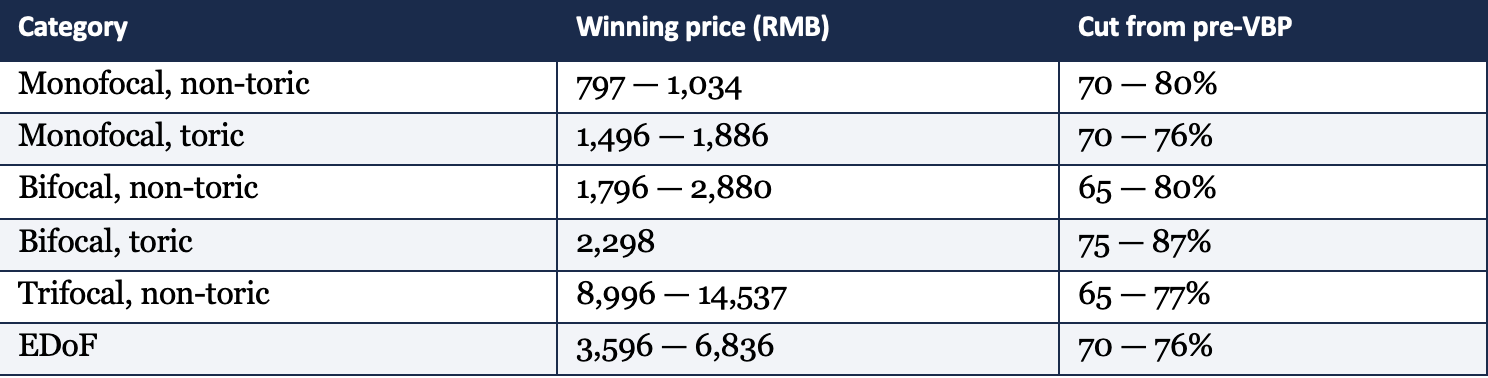
Enforcement has begun. In April 2025, the NHSA disqualified an Indonesian supplier from the IOL VBP for breach of its bidding commitments and suspended its eligibility through October 2026, the first public enforcement action since the 4th round opened. Commitments made under VBP should now be treated as enforceable. The renewal window opens in the second half of 2026, and the regulator’s language around the 6th round’s “anchor price” mechanism (January 2026) signals that the next round will not repeat the deep cuts of the last.
Where we go from here
This is the first public release of OphthalLogix Intelligence. We intend to keep tracking this market as it moves, provincial reimbursement updates, VBP enforcement and renewal, and hospital-level execution of the policies already on paper. We will publish further work as the picture clarifies.
If the subject is useful to you, subscribe, and you will be notified when we next publish.
— The OphthalLogix Intelligence Team
This report is for informational purposes only and does not constitute professional advice. OphthalLogix accepts no liability for decisions made based on this content.